

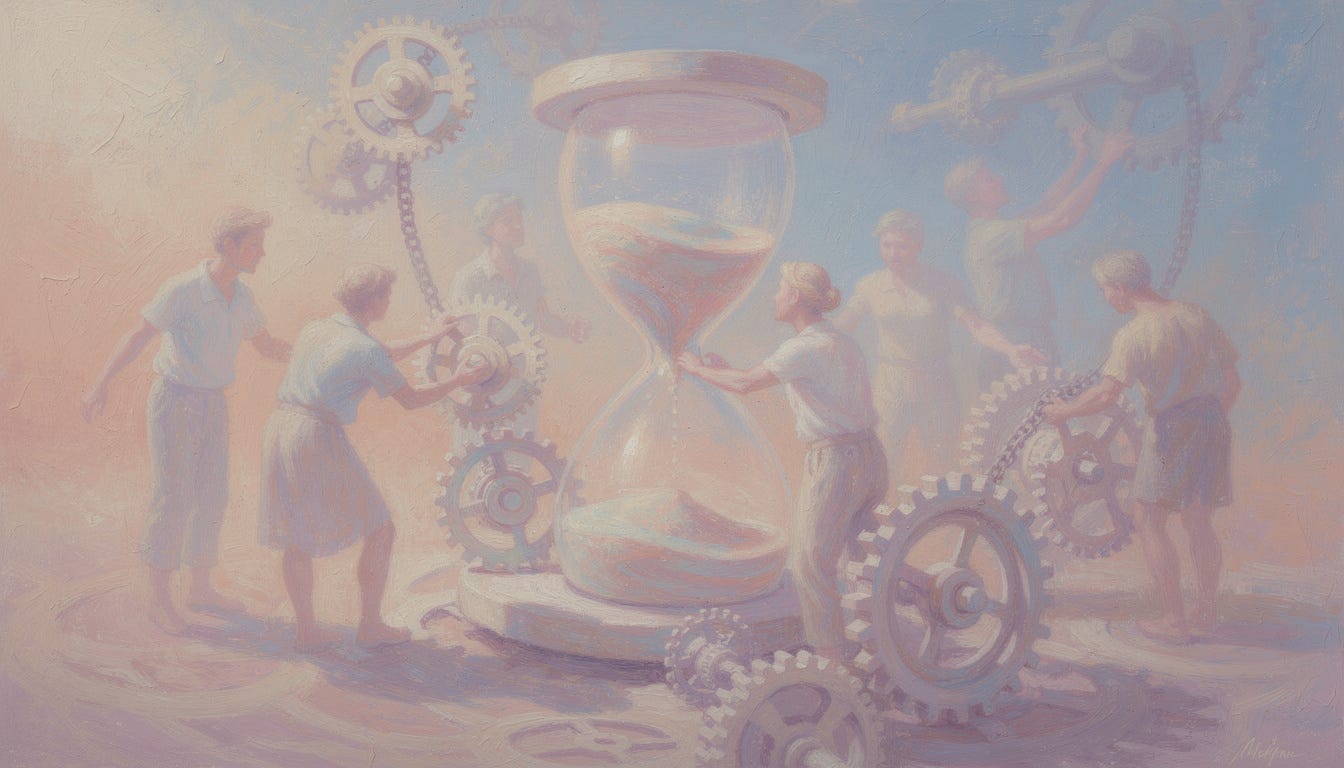
What if your five-year plan had to happen in six months?
as if your life depended on it.
Could you do it?
At first, you might think, “Okay, I’ll just work faster. Stay up later.”
But very quickly, you’ll notice something strange. Pushing harder doesn’t work for such efficiency gains. You simply run out of hours.
Because there’s a deep universal truth hiding underneath everything:
The universe gives us three directions in space, but only one direction in time.
That’s it. You can move left, right, up, down, forward, backward—but when it comes to time? You only get one step at a time. Always forward. Without skipping and rewinding.
So how do you do things faster? How do some people seem to live five lives at once?
The answer is leverage.
Leverage is how you get more output per unit of time.
I first saw this idea come to life in a short tweet from Andrej Karpathy. He was talking about why Transformer models (technology behind chatgpt) work so well. His words stuck with me:
“Breadth is free and depth is expensive.”
In simpler words: doing lots of things at the same time (breadth) is easy.
Doing one thing after another (depth) takes time—and time is expensive.
That statement felt like a hidden law of leverage to me.
Because we are taught that we should avoid multitasking. Do one thing at a time, and somehow this lesson takes us further from thinking in terms of leverage. And it feels unnatural to us when we encounter someone who has it.
Karpathy was talking about AI, but it felt true everywhere. I couldn’t unsee it.
It was like someone handed me a lens to look at the world. Suddenly, I saw everything differently.
Naval Ravikant popularised the idea of leverage in business through this statement:
“Fortunes require leverage. Business leverage comes from capital, people, code, and media.”
It made sense before. But now I felt it. I understood how it actually operates.
Leverage is a method that let you move work away from time and into space. By doing this, you go from being dependent on slow and one-by-one nature of time to using the fast and all-at-once nature of space.
Let’s take a simple example: adding 100 random numbers together.
Most people think you have to add them one by one, right?
1 + 2, then add 3, then 4… it’s slow. It’s all in a line.
But imagine you had 100 people helping you.
You pair up numbers at the same time. Then pair up the results.
And suddenly what used to take 100 steps now takes just a few.
That’s leverage.
Bill Gates didn’t build Microsoft by typing faster than everyone else.
He built systems. Thousands of people and millions of lines of code working in parallel.
Even now, when he’s not there, Microsoft still runs, still grows.
That’s what it means to shift from depth to breadth.
So how do you really apply this to your day to day life ? Imagine you have a list of tasks, 100s of them.
A good strategy would be to find leverage points—actions that unlock a chain reaction.
One smart move that sparks ten more.
But not everything can be done in parallel. Some things still move on the slow path of time. They’re stuck. They resist being sped up.
Like earning Google’s trust for SEO. Building backlinks? That part still takes time.
You can’t rush it.
These time-linked parts become your real bottlenecks—your biggest limits.
So what should you do?
Two things:
Move as much as you can into parallel work—hire, delegate, automate, code.
Handle the truly time-based stuff with care—plan for it, protect it, and don’t waste it.
Of course, this gets tricky with people.
People aren’t machines. They make mistakes. They forget things.
So you’ll need systems that catch errors and fix them.
But even those systems take time to build and manage.
That’s why some businesses—like consulting or handmade crafts—can only grow so far.
Their value is deeply tied to time, skill, and individual care.
So, the deeper insight here is that:
Great entrepreneurs know what can scale—and what can’t.
They push everything they can into parallel systems.
And they focus hard on solving the bottlenecks that truly need time.
This changes how you think.
You stop chasing to-do lists.
You start building machines.
You think in code, in teams, in systems, in content.
You build things that work while you sleep.
Look at what you’re building today.
Are you stuck going deeper into a time trap?
Or are you stepping sideways—into space, into systems, into leverage?
Ask yourself that. Be honest.
You can achieve big things if you stop going faster in a straight line and start moving smarter in every direction the universe allows. Use the three dimensions as much as you can, because in every moment, you have limitless quantity of it.